I built the company I needed.
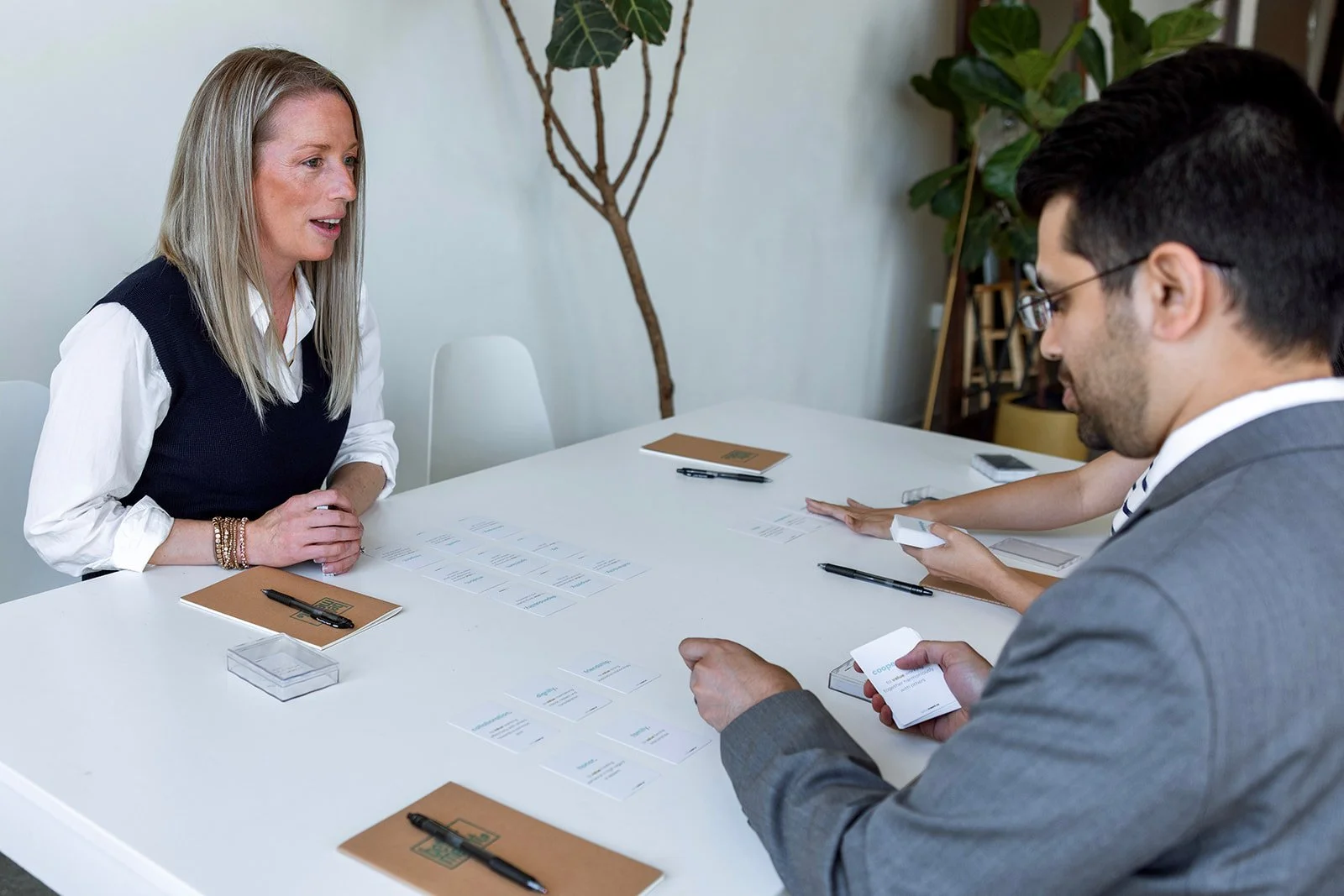
Sarah leading a values session with clients
Five years ago, I started Bettermeant because I believed work could be better. I still believe that; more deeply now than I did then. But five years, hundreds of leaders, thousands of conversations, and countless experiences have changed my understanding of what "better" actually requires.
The company I always needed
Before Bettermeant, I spent most of my career inside large companies; building teams, leading through reorganizations, managing people and being managed by them. I sat through leadership meetings, talent reviews, strategy sessions, and more corporate training than I can count. Since then I've also been a business owner, a coach, a board member, a working mom, and someone trying to figure out how to do meaningful work without letting work become the meaning of my life.
Looking back, I can finally say what I couldn't have articulated when we started: I built the company I had always needed.
I needed it as a new leader trying to figure out what leadership actually meant. I needed it when I was promoted into jobs I wasn't sure I was ready for, quietly wondering whether I was doing any of it right. I needed it when I knew exactly what to do and still couldn't make myself do it. I needed it on a Tuesday after a hard conversation, when I couldn't wait three weeks for a coaching session to make sense of what had happened. And I needed it most when my career looked successful from the outside while I was asking much bigger questions on the inside; about meaning, purpose, and what I actually wanted work to be in my life.
What training and coaching don't reach
The corporate world gave me a lot — real mentors, leadership programs, frameworks, coaches, books. I'm grateful for it. But most leadership development rests on a simple premise: teach people enough about leadership, and they'll become better leaders. So we teach communication, delegation, influence, feedback, strategy, change management. Then we assess whether people are competent at those things.
Training matters. Coaching makes it better — a good coach helps someone take what they know, understand themselves more deeply, and close the distance between knowing what to do and actually doing it. We believe in both, deeply. They're core to what we do.
But after five years sitting beside people in the moments when leadership gets real, I've come to believe there's a piece we've dramatically underestimated: identity.
There's a difference between knowing how to lead and believing you are a leader. Between understanding the mechanics of a difficult conversation and identifying as someone capable of courage when it counts. Between learning how to delegate and actually seeing yourself as someone whose job is to grow others' capability, not to keep proving your own.
That difference matters most exactly when things get hard — because most leaders we meet don't suffer from a lack of knowledge. They know they should have the conversation, make the decision, ask for help, admit they were wrong, address the thing everyone's been avoiding. And then the moment arrives. Fear shows up. Ego shows up. Doubt shows up. The need to be liked, right, or in control shows up. A perfectly capable person who could explain exactly what good leadership looks like suddenly can't do it.
The competency didn't disappear. Their access to it did.
Why this matters beyond any one leader
I don't think the workforce we're building for can run on supervision anymore. Work is changing too fast. Organizations are too complex and distributed for a small group of "leaders" to think, decide, and direct while everyone else waits for instructions.
The workforce of the future needs to be full of leaders — people who can make decisions without constant oversight, navigate ambiguity without shutting down, disagree without destroying trust, fail without deciding they are failures, and say "I don't know" without it costing them their standing.
There's a deeper reason this matters, too. Work has become disconnected from meaning for too many people, and no perk or program manufactures its way out of that. People want to matter. They want agency, growth, a sense that their hours are part of their life rather than something to endure until real life resumes. Leadership changes that relationship, because leadership creates agency. When I see myself only as someone completing assigned work, the job becomes transactional fast. When I see myself as someone capable of influencing what happens around me, work changes shape.
That doesn't excuse bad management or broken systems. It means the choice isn't only tolerate or leave. There's a third option: I can participate in making it better.
Meantorship: a category we had to name
Over five years, we noticed our work didn't fit the categories that already existed. Sometimes clients needed training, so we taught. Sometimes they needed coaching, so we asked questions and let them find their own answers. Sometimes they needed advice from someone who'd actually sat in the chair, so we gave it. Sometimes they needed a text five minutes before a hard meeting. Sometimes they needed someone beside them after the meeting went badly, helping them understand what happened and go back in tomorrow.
We eventually gave that a name: Meantorship.
Not because leadership needed another piece of jargon, but because no existing word covered what we'd learned people actually need. Training centers knowledge and skill. Coaching centers the individual's own awareness. Meantorship uses both, but centers something different: the identity of the person becoming a leader. We model it, teach it, coach it, advise around it, and walk alongside people while they test new ways of being in the actual mess of their actual work.
We're not trying to produce people who are excellent in a coaching session. We're trying to send people back into the world different.
Over time, "I'm trying to be more courageous" becomes actual acts of courage. "I'm learning to delegate" becomes real, comfortable use of power. That's not a claim of mastery — it's the opposite of one, and that's the point. Leadership development has spent decades on competence: learn the skill, demonstrate the behavior, prove you can do it. Somewhere in there, we produced a generation of leaders who learned to perform leadership before they learned to experience themselves as leaders.
LeaderID™: the model behind the shift
That distinction — performing versus experiencing — is the idea behind LeaderID: a person's sense of self as a leader, built across six dimensions.
Self — Do I know myself and trust my ability to grow?
Connection — Can I build real relationships, share power, and help others become more capable?
Purpose — Do I know what matters and direct my energy toward it?
Agency — Do I experience myself as someone with choices and the ability to act?
Impact — Do I believe I can affect the people and systems around me?
Openness — Can I stay steady when the world changes or I don't know what's next?
Knowing isn't the same as identifying. Think about an athlete: there's a difference between "I know how basketball is played," "I play basketball," and "I am a basketball player." A basketball player doesn't stop identifying as one because their shot needs work — their identity is what gives them the confidence to work on it. Practice isn't evidence they don't belong; it's part of being a player.
What if leadership worked the same way? What if we didn't have to spend our careers proving we'd earned the word, and could instead say: I am a leader, and I'm still learning how to lead?
Identity makes room for that. It lets us be unfinished without feeling insufficient, and it changes what we reach for in the difficult moment — not just a competency, but an answer to the question, who am I right now, and what part of my leadership do I need to access?
Twelve Leadership Pathways
That's where our twelve Leadership Pathways come in — two for each dimension of LeaderID:
Grounded and Growth-Centered strengthen Self
Trustworthy and Empowering enable Connection
Aspirational and Intentional deepen Purpose
Courageous and Accountable build Agency
Strategic and Influential expand Impact
Resilient and Adaptable build Openness
These aren't boxes to check or identities to master. They're places to strengthen so a person can access more of themselves as a leader, on demand. Sometimes I need to find the grounded leader in me before I walk into the room. Sometimes I need courage. Sometimes the most leadership I can offer is to stop solving and become more empowering.
And they give development somewhere practical to go. If someone struggles with Agency, telling them to "be more accountable" doesn't help much. We have to get underneath it: Do they have the emotional capacity to tolerate the discomfort of speaking up? The capability to challenge someone constructively? Can they apply it when the stakes are high and instinct says stay quiet? Now the work becomes personal and useful — not does this person know how to lead, but what's getting in the way of them experiencing themselves as the leader they're capable of being.
Development shapes identity. Identity shapes expression. Who I believe myself to be changes how I make decisions, use power, respond under pressure, and navigate what I don't yet know.
What our clients taught us
We didn't build this model in a conference room. Our clients built it with us.
They let us into the conversations behind the conversations — the fear under the confidence, the doubt under the title, the complicated middle between knowing and doing. They trusted us through promotions and failures, layoffs and new jobs, struggling teams and difficult boards, and moments when they genuinely didn't know what came next. They taught me something I wish I'd understood earlier in my own career: the best leaders aren't the ones who've finally figured it all out. They're the ones with enough confidence in who they are that they no longer need to pretend they have.
So this anniversary really is a love letter. To everyone who trusted a small company called Bettermeant with some of the biggest moments of your career and life — thank you. To every team that let us into the complicated, human reality underneath the org chart — thank you. To every Meantor who brought not just expertise but your own mistakes, curiosity, and humanity into this work — thank you. And, in a strange way, to the earlier version of me who needed this company long before she knew how to build it — thank you too.
What I understand now
Five years ago, we started Bettermeant to make work better. I understand that ambition differently now.
Better work doesn't come from creating a handful of extraordinary leaders at the top and asking everyone else to follow. It comes from building organizations full of people who know they can lead, and cultures that let them.
If we want people to lead differently, we have to change more than their skills; we have to change their experience of themselves as leaders. And if we want that leadership to last, we have to build workplaces that support and reinforce it.
Develop the person. Strengthen the identity. Change how they lead. Build a culture where that leadership can live.
That's the company I needed. Five years later, it's the one I feel lucky to be building along side of some of the most amazing people I have ever had the privilege of working with.
Not more followers. More leaders. Join us.