A Better Model for Leadership Development
What Is Meantorship™?
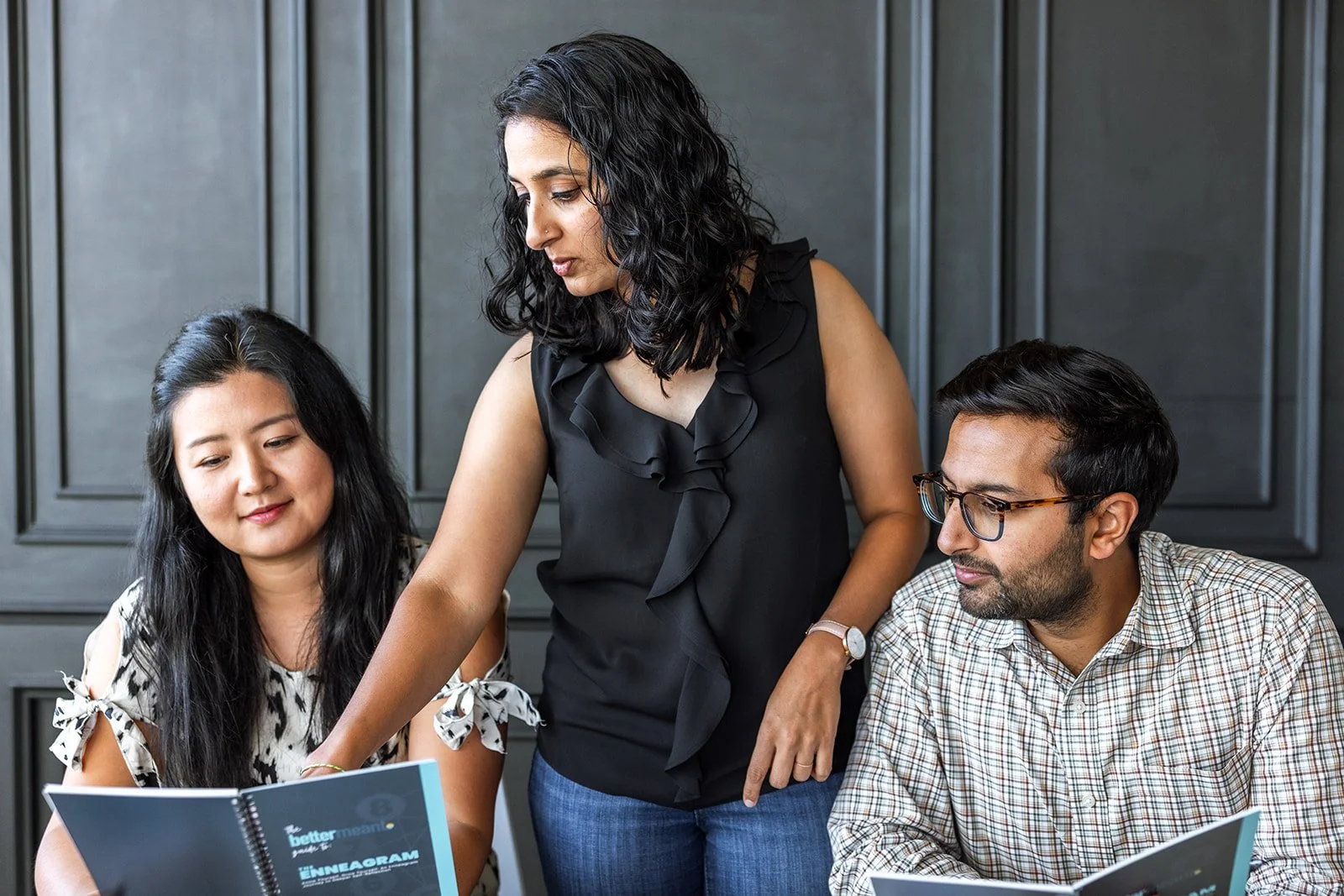
Ami Joshi walking clients through learnings in a Culture Lab
The world of work has changed faster than leadership development has. AI can summarize research, draft a strategy, write the email, analyze data, and surface ten frameworks before your next meeting starts. Information is more available than it has ever been, which means knowing more is no longer enough to make someone a strong leader.
What matters increasingly is what people do with what they know. Can they make sense of complexity? Exercise judgment? Create direction? Build trust? Adapt when the answer is unclear? Help other people move forward? These are becoming some of the most important capabilities in work, yet much of leadership development still relies on a familiar formula: attend a training, learn a framework, get some feedback, meet with a coach occasionally, then return to work and try to apply it all when the situation gets complicated.
At Bettermeant, we think leadership development can work better. That is why we created Meantorship™.
Leadership development has an application problem
Most leaders are not struggling because no one has ever told them they should delegate, communicate clearly, think strategically, give feedback, or set expectations. They usually understand the concept. The harder part is doing it when something meaningful is at stake.
Delegation feels very different when the work matters deeply to you and someone else may approach it differently. Feedback becomes harder when the relationship matters. Strategic thinking sounds obvious until your calendar is full and everything feels urgent. Setting a boundary is simple in theory until saying no has a real consequence.
This is one of the biggest lessons we have learned through thousands of hours working with leaders: the framework is rarely the hardest part. The application is.
That is why our work focuses not only on leadership capability, but also on the capacity underneath it. We look at mindset, skill, behavior, context, support, and the internal patterns that determine whether someone can actually use what they know when the moment gets hard.
What is Meantorship™?
Meantorship™ is Bettermeant's model for continuous, real-world development and support. It combines coaching, mentorship, advising, strategic thought partnership, practical tools, and accountability based on what the person and the moment actually require.
Sometimes the most useful thing is a question that helps someone see a situation differently. Sometimes it is advice from someone who has been in a similar seat. Sometimes it is a framework, a conversation plan, a challenge to an assumption, or space to think through a decision before acting.
We are less interested in defending the boundaries between coaching, mentoring, advising, and development than we are in helping people move forward. The modality is not the point. Growth is.
The goal of Meantorship is to help people understand themselves more deeply, see their situation more clearly, and become increasingly capable of choosing how they want to lead.
The capacity underneath the capability
Traditional leadership development tends to focus heavily on capabilities: how to delegate, communicate, coach, manage performance, influence others, and think strategically. Those skills matter, but there is another layer underneath them that receives far less attention.
Can I tolerate the discomfort of uncertainty? Can I stay grounded when someone disagrees with me? Can I give up control when someone else owns the outcome? Can I hear difficult feedback without becoming defensive? Can I make a decision before I have perfect information? Can I remain curious when I would rather be right?
Those questions get much closer to the reality of leadership.
We believe leadership development has to work on both levels. People need useful skills and frameworks, but they also need the internal capacity to use those tools when pressure, emotion, ambiguity, power, identity, or relationships enter the picture. That is where leadership becomes much more than a collection of competencies.
Leadership in the age of AI
For a long time, expertise created authority. The person who knew the most often held significant value in an organization because information was harder to find, synthesize, and apply.
AI is disrupting that equation. Information is becoming abundant and many forms of knowledge work are becoming faster and less expensive. That does not make leadership less important. It changes what leadership needs to be.
The advantage increasingly comes from judgment, discernment, curiosity, agency, courage, empathy, adaptability, influence, and self-awareness. AI can produce an answer, but someone still has to decide whether it is the right answer for this moment, this business, this team, and these people. Someone still has to make the call, create meaning, communicate direction, and bring other humans with them.
That is why one of the questions shaping our work at Bettermeant is no longer simply, "What do leaders need to know?" We are asking, "Who do people need to become to lead well in what is coming?"
That question changes leadership development significantly.
Leadership should start before the title
Organizations also tend to wait too long to develop leadership. People can spend years being rewarded for execution, expertise, and individual contribution. Then they are promoted and suddenly expected to demonstrate judgment, influence, strategic thinking, accountability, and the ability to develop others.
We believe leadership should begin much earlier.
At Bettermeant, leadership is a mindset rather than a position. It is the willingness and ability to take ownership, create direction, influence what happens next, and contribute to something beyond yourself. Those behaviors can be developed long before someone manages a team.
In fact, we believe the strongest organizations of the future will distribute leadership more broadly. They will create cultures with more people who can think, make decisions, act with agency, take responsibility, and move work forward without waiting for power to come from the top.
Support should be part of the system
There is another assumption about work that we think needs to change: the idea that support is primarily something people need when they are struggling.
Support is not evidence that someone cannot handle the work. Done well, support is part of the infrastructure that helps capable people do exceptional work.
Clear expectations are support. Useful feedback is support. Knowing what good looks like is support. Having someone challenge your thinking before a consequential decision is support. Having access to perspective before a problem becomes a crisis is support.
Over time, many organizations have become faster, flatter, and leaner. Some of that change has been positive, but it has also removed many of the informal structures through which people once learned, received guidance, and made sense of work. At the same time, more responsibility for finding mentors, development, perspective, and support has been pushed onto the individual.
Meantorship™ puts some of that structure back around people. The goal is not dependency. The goal is greater agency, judgment, confidence, and capability over time.
What Meantorship™ looks like in practice
The work looks different depending on the person because leadership happens in context.
An emerging leader may be learning how to trust their judgment and influence without formal authority. A senior executive may need a place to think clearly when everyone around them wants something. A founder may understand delegation perfectly well but still struggle with the emotional reality of letting go. A team may need to understand the behavioral patterns underneath its conflict before another communication workshop will make any difference.
An organization may need something bigger still: a shift away from treating leadership development as a collection of programs and toward creating an environment where leadership develops through the way work actually happens.
The situations are different, but the goal is similar. We want people to become more capable of leading themselves, other people, and the work in front of them.
A better model for what comes next
We do not think the future of leadership development needs more content for content's sake. It needs better integration between what people know, how they behave, what they have the capacity to hold, and the environment around them.
Development needs to happen closer to the moments where leadership is actually required. Support needs to strengthen agency rather than replace it. Organizations need to develop leadership earlier and more broadly. And the work itself needs a much more human understanding of what actually creates behavior change.
That is what we are building at Bettermeant.
Leadership as a mindset. Support as part of the system. Development designed for real life.
That is Meantorship™.